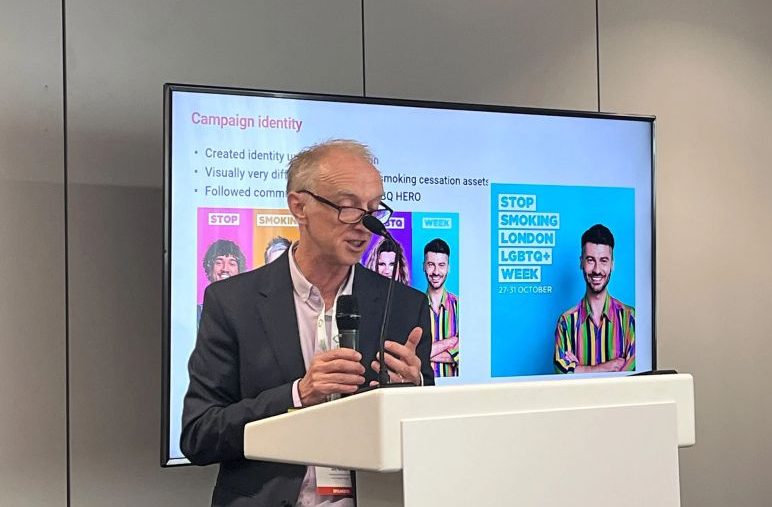
London Tobacco Alliance LGBTQ+ Campaign presented at SCaH 2026
Jon Winter from the London Tobacco Alliance attended the SCaH Conference 2026 in Birmingham to share insights from London’s first Stop Smoking LGBTQ+ Week in October 2025.
Jon highlighted what we learned, what impact we saw and how it’s shaping our approach for our Stop Smoking London LGBTQ+ Week 2026 campaign which launches on 26 October 2026.
Jon talked through:
- Who the London Tobacco Alliance is
- Why we created this campaign
- How we developed the campaign
- How we built the campaign identity
- How we deployed it
- What impact we saw
- And finally, reflections and learning for the next phase in October 2026
Why we created the LGBTQ+ campaign
We launched this campaign in line with our efforts to focus on smoking-driven health inequalities. There was clear evidence that:
- Higher smoking rates exist in LGBTQ+ communities
- Nicotine is often used to manage stress and anxiety
- There is a lack of representation in mainstream smoking cessation campaigns
- There is a need for culturally competent, community‑led support
Partners across London told us they wanted resources that felt authentic, inclusive and relevant and that they could deploy locally.
We also recognised that a focused week would allow deeper engagement, stronger partner involvement, and clearer visibility.
This became London’s first LGBTQ+ smoking cessation campaign, co‑created with LGBT HERO a national health and wellbeing charity trusted by LGBTQ+ communities.
How we developed the campaign
We started with analysing available data, insight and community engagement insight.
- Analysed smoking prevalence and behavioural patterns
- Engaged community representatives
- User‑tested visuals, wording and tone
- Focused on inclusivity, resonance and authenticity
- Commissioned LGBT HERO to develop the campaign and co‑create content
- Designed resources for both community members and professionals
With a small budget, partnership was essential. We wanted assets that were easy for boroughs, NHS teams and voluntary organisations to deploy and use locally.
The aim was simple: Create something that felt genuinely LGBTQ+, not a general campaign with a rainbow added.
Creating the campaign identity
We developed a distinct visual identity deliberately different from mainstream cessation campaigns.
Through testing with LGBT HERO, we refined:
- Colour palette
- Typography
- Imagery
- Tone of voice
The identity needed to feel safe, welcoming, and community‑owned. And the feedback confirmed we achieved that.
Campaign deployment
We deployed the campaign across multiple channels and formats.
A dedicated LGBTQ+ webpage
Hosted on Stop Smoking London, featuring:
- Real stories
- Expert advice
- Daily themes
- Clear signposting
- Smoke Free app promotion as a safe space
Partner communications pack
Including:
- Images
- Copy
- Social posts
- Video clips
- Daily content for both community members and professionals
Social media channels
We posted across:
- TikTok
- Bluesky
- YouTube
Community‑focused channels
We used trusted LGBTQ+ spaces and platforms:
- Leaflets co‑produced with LGBT HERO, distributed in LGBTQ+ venues
- Ads on Grindr
- Lead article in FS Magazine
This was crucial meeting people where they are, not where we assume they may be.
Lived experience content
We filmed members of the community sharing their quit stories. These stories were powerful, relatable and authentic and they became some of the most engaged content of the week.
They reinforced the message that quitting is possible, support is available, and you’re not alone.
Professional content
Each day included content targeted at professionals.
On the Wednesday we ran a webinar with over 50 attendees live, and many more watching the recording afterwards. Watch the Supporting LGBTQ+ people to stop smoking webinar recording (2025).
Speakers included:
- Michael Brady, National Clinical Director for LGBTQ+ Health
- Tristan Barber, Consultant in HIV Medicine
- Oscar Moreno, GSTT
Their insights helped professionals understand the specific needs, barriers and opportunities within LGBTQ+ communities.
Clinical expert content
This reinforced:
- Inclusive support
- Professional relevance
- The importance of culturally competent care
Community‑Focused Channels
We also made sure the campaign reached people in trusted LGBTQ+ spaces where health messages feel more relevant and comfortable.
We co‑produced leaflets with LGBT HERO and distributed them in LGBTQ+ venues across London. Bars, clubs and community centres are often where people feel most at ease and partners told us that physical materials still matter.
We ran ads on Grindr, which delivered exceptionally high visibility. And we secured a lead article in FS Magazine, giving us a strong editorial presence within LGBTQ+ media.
These channels were essential. They helped us meet people where they are, not where we assume they are and they gave the campaign authenticity and reach.
Smoke Free App
Early research showed the app had particular resonance with LGBTQ+ communities. What LGBTQ+ people told us about the Smoke Free App.
People valued:
- Anonymity
- Digital accessibility
- Non‑judgemental tone
- Inclusive design
- Peer support features
Promotional assets included QR codes linking directly to the app.
This became a core part of the campaign.
Campaign outputs and impact
The results were strong:
- LGBTQ+ webpage: third most visited during the week
- Instagram: 143,634 impressions
- Grindr ads: 155,419 impressions
- Professional video: 1,600+ views
- Strong feedback from LGBTQ+ partners
- Good borough engagement — especially those with larger LGBTQ+ populations
For a first‑time campaign with a modest budget, this was a significant impact.
Reflections and learning
We learned a lot and it’s shaping our 2026 campaign.
Key reflections:
- Strong relationships with LGBT HERO and clinical leads were essential
- Trusted channels and voices matter
- LGBTQ+ campaigns must be distinct, not simply adapted from general population campaigns
- Community networks amplify reach
- Real imagery is more powerful than stock photography
- Leaflets and posters in clubs, venues and sexual health clinics work well
- The Smoke Free app is a valuable tool for this audience
For 2026, we’re:
- Surveying the community for deeper insights
- Securing real‑people imagery
- Increasing use of community networks
- Expanding in‑app advertising (HER as well as Grindr)
- Exploring attitudes, barriers, and preferences for inclusive support
Conclusion
There is clear evidence of the need for inclusive, tailored support. This campaign showed strong engagement across London and highlighted our collective commitment to tackling smoking inequalities.
You may also like
View all News and Events
Ground-breaking survey shines new light on smoking rates in London’s LGBTQ+ community
New Cochrane review strengthens evidence for vaping as a smoking cessation tool